Monday, February 26, 2007
Robocop, Pacemakers, and a Urinal
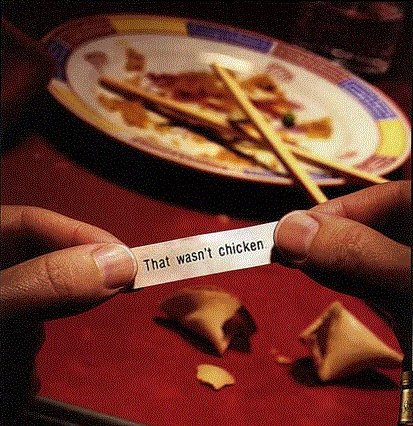
In discussion of Lexia to Perplexia, the idea that a well-known artist once submitted a urinal to an art museum was brought up. If an art museum showcased the urinal I’m sure there gathered a group of spectators wondering about the meaning and trying to decipher the symbolism of the urinal. Perhaps the artist is referring to the misplacement of something in society, maybe the urinal in a traditionally classy place out in the open depicts society in outrage about taboo sexual acts. (Pretty good, huh?) Or maybe the artist was drunk and thought it the ultimate joke! As the museum-goers tilt their heads and squeeze their chins pensively, the artist is slamming a bottle of jack and laughing his ass off! Now I don’t know if any of this is true, but I think reading meaning into a urinal is stupid. My friend attends an art school and the last time I visited him, he had a new painting in his living room: it was a kitchen scene with a man looking straight at the audience. What could it mean? The way the cabinets were washed in color instead of really painted perfectly, perhaps this carries a message. Maybe we should just all calm down about playing detective, take off the Sherlock Holmes get up, and put down the Nancy Drew book. I say the same for Lexia to Perplexia. Someone asked “how do we know this wasn’t created by a schizophrenic with computer access?” I think this is a VERY valid point. Sure it’s weird; but that doesn’t give it supreme meaning. Fortune cookies are weird: they are also mass produced in some warehouse in Ohio. I once dated a guy who thought being “artistic” meant being difficult to understand. First, I’d like to say this strategy gets you no where with the ladies. But, once I asked him what this completely messed up poem he had written was about and what it meant to him. He told me that HE didn’t even know, and I was the first person who ever asked him that. Everyone else apparently felt too much in shadow of his “brilliance” and “creativity” to ask. Sure Lexia to Perplexia has an “edu” site, but maybe the assignment was to make the most cracked out and complex website. If you still feel the need to dig for meaning, let me ask you this, “isn’t trying to pinpoint the one, perfect, exact meaning to something meant to be artistically confusing and intended to give different meanings to each view destroying the author’s true meaning?” (How’s that for trippy, um I mean, meaningful?)


Tuesday, February 20, 2007
McLulan
Really, I think that Marshall McLulan addresses in his chapters “The Medium is the Message” and “Media Hot and Cold” the ways in which society interacts with literature. He discusses the effects of media coverage in politics. Napoleon is quoted in saying “Three hostile newspapers are more to be feared than a thousand bayonets” and McLulan also mentions writings effect on the French Revolution: “the printed word that, achieving cultural saturation in the eighteenth century, had homogenized the French nation”. When the general public gains access to the printed word, and thus a freer means of mass communication by the masses for the masses, there is often times a displacement of power from those who previously held it into the hands of the people. One of the first mass produced books was the Bible, and the widespread printing of the Bible released the power from the church. McLulan also addresses the different reactions to either “cold” or “hot” media depending on if it is introduced to a “hot” or “cold” culture. “Nevertheless, it makes all the difference whether a hot medium is used in a hot or a cool culture”, he says on page 43.
Wednesday, February 14, 2007
Where are we going in this handbasket?
In the article “Rhetorics Fast and Slow”, by Lester Faigley, I just kind of felt like saying, “get over it”. “Fast has overwhelmed slow” and “speed brings risks” Faigley says on page 7 when discussing what he calls fast (internet, cell phone) and slow (dialog, books) rhetorics. He condemns fast rhetorics as a “manifestation of a culture that suffers from attention deficit disorder” (pg. 9) and cites courses of study one of the remaining places where slow rhetoric can still be learned and practiced. Personally, I’d like to let Faigley know that like it or not, rhetoric is moving the way of our culture and society in general. Either schools can adapt to the changes and include some fast rhetoric, or students will find it increasingly difficult to relate to their schoolwork. Know that I am not saying “aol instant messager” or text messages should replace talking in person or that wikipedia should take the role of text books. However, technologies should be incorporated into what students learn. I agree with the discussion we had in class about teaching students why wikipedia is not an acceptable source for college papers. Yet, teaching reasons why wikipedia is not to be used and what constitutes a credible source would do hundreds of times more good than producing a letter condemning any student who uses wikipedia; which is exactly what gets under my skin about “Rhetorics Fast and Slow”. The language surrounding fast and slow rhetorics lifts slow rhetoric to godliness (it helped to end slavery, is “the means for which dreams to be articulated”) while fast rhetoric becomes risky, “going faster and faster leads to more accidents”, and is compared to disease, famine, and natural disaster of past times. Really? If fast rhetoric should be put into the “disease, famine, and natural disaster” category of things to worry about I think the whole world is going to crash and burn.
Thursday, February 1, 2007
Not cool enough for Winter...
Those super huge sunglasses? They look alright on people who aren’t me, but they definitely do not keep me warm. Nope, if you see me from the months of January to March you will not recognize me. (Really, I can walk right up to close friends and they don’t recognize me.) I’ll bundle up until only my eyes are showing if that’s what it takes. We’re talking about sweat pants under jeans. Honestly. So after passing the joggers on their way to the SERF wearing cropped sweat pants and the girl in a Malibu Barbie pink coat whom was blocking her face from the well below zero windchill with gianormus sunglasses it hit me: I’m just not cool enough for winter. I’m that kid from “A Christmas Story” when he can’t even put his arms down at his sides. No straight iron for me before heading to class. I haven’t out grown the “comfort before style” motto, and I don’t think I will. This is the last straw. I’m writing winter off. Really I won’t have to see much of it anyway; I’ve already blocked out all of my peripheral vision with a sweatshirt hood. I’m moving to California and that’s that. Somewhere warm. Somewhere that has sand banks hugging the ocean right now instead of snow banks and salty streets. A place I’ll enjoy taking strolls under the warm night sky instead of bolting miserably from place to place. Am I the only one who remembers the summer: when you could go to the capital bars in the cutest strapiest wedge heels you own? (Sorry, guys I guess you’ll have to imagine.) People wore colors like red and orange and bright blue, not just grey and black and navy. Summer nights that stay light until almost 9:30. Boating, swimming, bon fires, outdoor seating at restaurants, driving with the windows down! It was grand. There are even beach screen savers on my computer and palm tree wallpapers on my phone to tease me! Think of all the songs written about warm weather! I don’t remember the last time I heard a song and thought “Oh yea! I can’t wait until I can’t feel my fingers or nose!” So if you see me around campus or when I’m coming into class shedding layers know that I’m silently giving winter the finger.
Monday, January 29, 2007
Rhetoric?
I have heard the word rhetoric only once, and that was when my Communications major roommate was trying to decipher the meaning for a class. What I got out of that conversation was that rhetoric is speech (both formal speeches and everyday communicating) and the kind of language and means used to deliver and receive that speech. After reading James A. Herrick’s "An Overview of Rhetoric" I think my definition was pretty much on the money with a few exceptions. I need to include the aspect of persuasion from my definition. Mainly though, he mentions many times the two categories of: 1) what was said and 2) how it was said, or the content and form respectively, which is a much more clear way to phrase what I tried to articulate. It’s not surprising though that “rhetoric” is a commonly used word about which many people have differing definitions seeing as it has been in use since Plato’s times. One thing I still do not understand, however, is how the study of rhetoric could have been “at odds with religion, philosophy, and science at times”, as Herrick states. Even in medieval times when religion often opposed philosophy and science, I do not see how studying language and its “means and meaning” could disagree with any of the three fields listed.
Thursday, January 25, 2007
Starting Out
My name is Miranda and I am currently a graduating senior at UW-Madison with one major class and a "Comm b" requirement standing in my way. It's this requirement that lands me for my first time in the writing center on the sixth floor of Helen C. White at 9:30 am where I'm told my "Intermediate Writing" class (read: dull papers and lots of them) is really "Rhetorics of Network Culture" (read: what?!). And, despite dreading the eventual over-the-shoulder look from teachers that reminds me very much of elementary school arithmetic, I am here typing an online, open-to-public blog which is technically intended as an introduction. In way of that introduction:
My Likes:
summer
sleeping in
sand in your toes, hair, and teeth after a day on the beach
front porches
friends and family and my old, crabby cat
puppies, and the idea of getting one
football
glitter
shopping, looking at, and owning shoes
the colors red and turquoise
My Dislikes:
cold, face-scraping wind
traffic
rude people
dry skin on your hands
My Likes:
summer
sleeping in
sand in your toes, hair, and teeth after a day on the beach
front porches
friends and family and my old, crabby cat
puppies, and the idea of getting one
football
glitter
shopping, looking at, and owning shoes
the colors red and turquoise
My Dislikes:
cold, face-scraping wind
traffic
rude people
dry skin on your hands
Subscribe to:
Posts (Atom)